



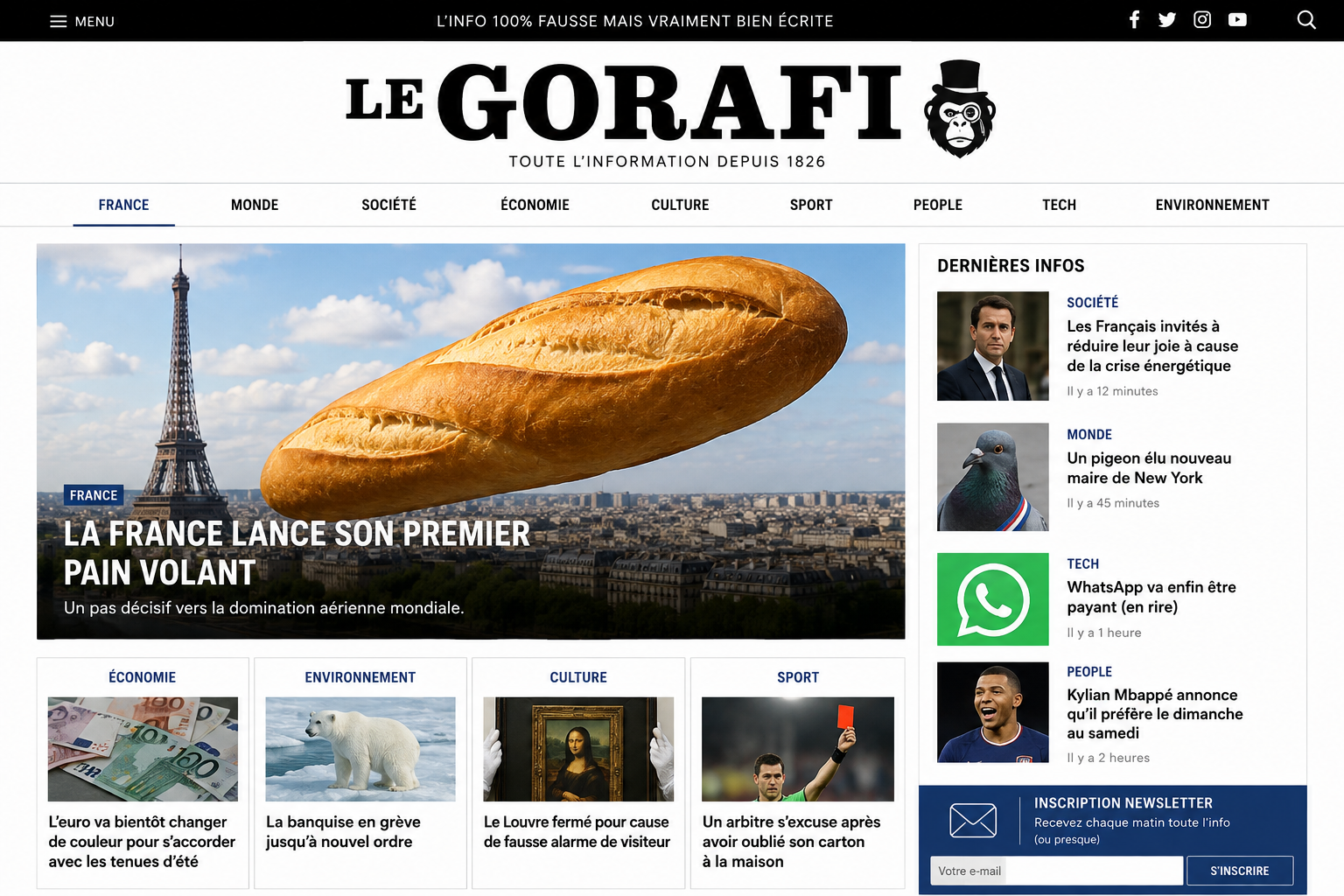
If you have come across the question quel site parodique américain les a inspirés ? the answer most commonly associated with Le Gorafi is The Onion, one of the best-known satirical news publications in the United States.
The connection is understandable. Both publications use the language, structure, and visual conventions of conventional journalism to create fictional stories designed to look like real news. Their headlines can sound plausible at first glance, while the underlying story gradually reveals an absurd, ironic, or deliberately exaggerated situation.
However, the relationship deserves some context. Saying simply that The Onion “created” or directly caused Le Gorafi would be an oversimplification. French satirical journalism has a much longer history, and Le Gorafi exists within a broader tradition of parody, political humor, fake newspapers, and absurdist comedy.
Still, when people ask which American satirical website inspired the French publication, The Onion is the name that comes up most often.
Quick Facts
| Fact | Answer |
|---|---|
| Primary keyword | quel site parodique américain les a inspirés ? |
| American satirical website | The Onion |
| Country | United States |
| Founded | 1988 |
| Main format | Satirical news |
| French publication associated with the question | Le Gorafi |
| Le Gorafi launched | 2012 |
| Writing style | Fake news presented in a journalistic format |
| Article language | English |
| Content standard | Fact-based |
What Is The Onion?
The Onion is an American satirical publication known for presenting fictional stories in the style of conventional journalism.
Founded in 1988, it developed from a college newspaper into a major satirical media brand. Its humor is based on treating absurd ideas as though they were ordinary news events.
This approach is central to The Onion’s identity.
Instead of simply telling readers that something is ridiculous, a typical Onion story adopts the tone of a serious newspaper report. It can use a conventional headline, quotations, statistics, political references, and other elements associated with journalism.
The contrast between the serious presentation and the absurd content creates the joke.
That format became particularly influential because it allows satire to imitate the appearance of real news while exaggerating recognizable aspects of politics, culture, business, technology, and everyday life.
What Is Le Gorafi?
Le Gorafi is a French satirical news website that publishes fictional stories written in the style of news reports.
The name itself is a parody of the French newspaper Le Figaro. The publication became known for humorous headlines and articles that imitate the language of mainstream journalism.
Its stories are fictional. Their purpose is satire and comedy rather than the distribution of factual news.
This distinction is important because fake-news satire can sometimes be mistaken for genuine reporting, particularly when individual headlines are shared without context on social media.
Le Gorafi’s success demonstrates how effective the fake-news format can be when adapted to a particular language and culture.
French readers can recognize references to French politics, institutions, social habits, media culture, and everyday life. The basic satirical mechanism may resemble American examples, but the jokes depend heavily on the cultural environment in which they are written.
So, Which American Satirical Website Inspired Them?
The short answer is:
The Onion.
The Onion is the American satirical news publication most closely associated with the format used by Le Gorafi.
Both publications rely heavily on the same broad comedic technique: presenting invented events as if they were legitimate news.
That does not mean every joke or article published by Le Gorafi is copied from The Onion. Nor does it mean The Onion was the only influence on French satirical journalism.
Rather, The Onion provides a particularly clear international comparison because both publications built their identities around news-style satire.
Why The Onion Matters to the History of Satirical News
The Onion’s importance goes beyond individual jokes.
Its distinctive format helped establish satirical news as a recognizable form of online entertainment. Readers became familiar with the idea that a publication could deliberately imitate a newspaper while publishing fictional stories.
This format works because journalism has a recognizable vocabulary.
News headlines tend to use concise language. Articles often begin with a summary of the event. Reports may include statements attributed to officials or fictional experts. Stories may contain apparently precise details.
Satirical publications can reproduce these conventions and then introduce something that is obviously absurd once the reader examines it closely.
The resulting humor comes from the collision between journalistic form and ridiculous content.
Le Gorafi operates within this same general tradition.
The Difference Between Satire and Fake News
Understanding the difference between satire and misinformation is particularly important today.
A satirical website intentionally publishes fictional material for humorous or critical purposes. Its objective is not to deceive readers into believing that the fictional event actually occurred.
Misinformation, by contrast, involves false or inaccurate information that is presented or circulated as factual information.
Satirical publications may deliberately imitate the appearance of genuine news, which can sometimes create confusion when individual stories are removed from their original context.
That is why identifying the source matters.
A headline from The Onion or Le Gorafi should not automatically be interpreted as a factual report simply because it resembles the style of a conventional news article.
Why Does The Format Work So Well?
The popularity of satirical news has a simple explanation: people understand the conventions of journalism.
Most readers know what a conventional headline looks like. They are accustomed to phrases such as “officials said,” “according to sources,” or “experts believe.”
Satirical writers can use those conventions to create an expectation.
The reader initially interprets the headline as news. Then an unexpected detail appears.
For example, a fictional story might describe an ordinary political announcement but introduce an impossible policy or an exaggerated character reaction.
The humor emerges from the discrepancy.
This technique is especially effective online because headlines are often encountered without the complete article. A reader may see only a few words in a social media feed before deciding whether a story is believable.
That makes the distinction between satire and factual reporting more important than ever.
The Cultural Adaptation From America to France
One of the most interesting aspects of the relationship between The Onion and Le Gorafi is cultural adaptation.
Satire cannot simply be translated word for word.
A joke that works in the United States may not work in France because political institutions, cultural references, media personalities, and social conventions are different.
Le Gorafi therefore uses the basic concept of news parody within a French cultural framework.
Its headlines and stories draw on situations that French readers can immediately recognize. The humor often comes from exaggerating familiar institutions, social behaviors, political debates, or everyday frustrations.
This is an important distinction between influence and imitation.
An influential model provides a format or idea. A successful publication then develops its own voice and subject matter.
Why The Onion Is So Recognizable
The Onion’s style has become recognizable because it consistently maintains a serious journalistic tone while describing fictional situations.
That consistency is part of the joke.
The writing does not usually announce that the story is a joke in the headline. Instead, the humor depends on the reader recognizing the absurdity behind the professional presentation.
The Onion has also covered a wide variety of subjects over the years, including politics, entertainment, technology, business, science, and social issues.
Its long history has made it an important reference point whenever people discuss modern satirical news websites.
The Importance of Headlines
Headlines are particularly important to both traditional journalism and satirical journalism.
A good satirical headline has to achieve several things at once.
It needs to resemble something that could appear in a legitimate news publication. It needs to be understandable quickly. Most importantly, it needs to contain an unexpected element that creates the comic effect.
This is one reason the format is so effective online.
People increasingly encounter news through headlines rather than complete articles. Satirical publications can exploit that habit by creating headlines that look plausible but become increasingly absurd when examined carefully.
The headline itself can therefore function almost like a joke.
Did The Onion Invent Satirical News?
No.
This is another important distinction.
Satirical journalism existed long before the internet and long before The Onion was founded.
Political cartoons, parody newspapers, humorous magazines, fictional news reports, and other forms of media satire have existed for generations.
The Onion belongs to that much broader history.
Its particular contribution was to develop a highly recognizable modern form of satirical news and establish it as a major publication format in the digital era.
Similarly, Le Gorafi did not invent French media satire. It became a prominent modern example of it.
The Role of Social Media
Social media dramatically changed how satirical news is consumed.
A reader can encounter a headline without knowing the publication that originally produced it. Someone may screenshot a headline, repost it, or quote it without providing the original context.
Once that happens, satire can be mistaken for factual reporting.
This phenomenon is not unique to The Onion or Le Gorafi.
It reflects a larger challenge created by online information ecosystems: readers often have to determine whether a statement is factual, satirical, speculative, misleading, or completely fabricated.
Checking the original source is therefore one of the simplest ways to determine what kind of information you are reading.
Why People Search for quel site parodique américain les a inspirés ?
The exact search phrase quel site parodique américain les a inspirés ? is essentially asking for the American reference behind a French satirical publication.
For readers discovering Le Gorafi, the comparison with The Onion is useful because it provides an immediate explanation of the format.
Someone unfamiliar with Le Gorafi may understand it quickly after learning about The Onion: it is a publication that uses the conventions of news reporting to create satire.
However, the comparison should not erase the individuality of either publication.
The Onion developed within American media culture, while Le Gorafi developed within French media culture.
Their languages, references, political environments, and comedic traditions are different.
The Onion and Le Gorafi: A Simple Comparison
| Feature | The Onion | Le Gorafi |
|---|---|---|
| Origin | United States | France |
| Language | English | French |
| Type | Satirical publication | Satirical publication |
| Main technique | Fictional news presented as journalism | Fictional news presented as journalism |
| Cultural setting | American | French |
| Founded | 1988 | 2012 |
| Relationship | Major American reference for news satire | French publication associated with the same format |
The table illustrates why The Onion is such a natural answer to the question.
The publications are not identical, but their fundamental approach to satirical news is closely comparable.
A Broader Tradition of Parody
It would nevertheless be inaccurate to describe the entire concept of Le Gorafi as an American import.
French culture has its own long tradition of media parody and political satire.
Publications such as Hara-Kiri demonstrated the strength of French satirical journalism long before the emergence of online publications.
France also has a long history of political cartoons and satirical magazines.
Consequently, the development of Le Gorafi can be understood as part of several overlapping traditions: French satire, parody journalism, Internet humor, and the international influence of publications such as The Onion.
This broader perspective provides a more accurate picture than the simple claim that one website directly inspired another.
Why Fact-Checking Still Matters With Satire
Satirical websites are designed to entertain and provoke thought, but readers should still check the source before sharing a surprising claim.
If a headline seems extraordinary, identifying the publication is a useful first step.
If it comes from a known satirical outlet such as The Onion or Le Gorafi, the reader should understand that the story is fictional.
If the same claim appears on a conventional news website, additional verification may be necessary.
This is particularly important when satire is used in political discussions, where a fictional headline can easily be presented out of context.
Frequently Asked Questions
What American website inspired Le Gorafi?
The American satirical publication most commonly associated with Le Gorafi’s inspiration is The Onion.
Is The Onion a real news organization?
The Onion is a satirical publication. Its stories are fictional and are written as parody rather than conventional factual journalism.
Is Le Gorafi real news?
No. Le Gorafi is a French satirical publication. Its articles are fictional and intended as humor and satire.
When was The Onion founded?
The Onion was founded in 1988.
When did Le Gorafi launch?
Le Gorafi was launched in 2012.
Are The Onion and Le Gorafi the same website?
No. They are separate publications from different countries. The Onion is American, while Le Gorafi is French.
Did The Onion invent satire?
No. Satirical journalism and parody existed centuries before The Onion. The Onion is better understood as an influential modern example of satirical news.
Final Answer: Quel Site Parodique Américain Les A Inspirés ?
If the question refers to Le Gorafi, the answer is The Onion.
The Onion is the American satirical news publication most closely associated with the news-parody format that Le Gorafi also uses. Both turn fictional situations into mock news reports, using serious journalistic language and recognizable media conventions to create humor.
At the same time, it is important to avoid presenting the relationship as a simplistic one-to-one origin story. French satire has its own deep history, and Le Gorafi developed its own French voice, references, and comedic style. bilan magazine